A few days ago, I was texting with a former schoolmate — someone I like, someone who clearly means well — and they asked me something along the lines of:
But won't you apply for an actual job where you get paid, so you can earn a little bit of money and even network to grow your own business?
They didn't say it to be cruel. They said it because they care. And that is exactly what makes it so worth examining.
Because buried inside that question are at least three assumptions that most people never interrogate, and that quietly do enormous damage to the people who are trying to build something real.
Assumption one: A paycheck is proof of work.
When you are on someone else's payroll, the world treats it as settled — you have a job, you are earning, you are being productive. Nobody asks you to justify it. Nobody wonders aloud whether it is "real." The employer's willingness to pay you is treated as external validation of your value and your effort.
But when you are building your own company — especially in the early stages, especially when revenue has not yet arrived — the same world sees a gap. A void. An absence of proof. Because the proof they are looking for is someone else's signature on a contract that says you are worth something.
That is not a measure of work. That is a measure of whose permission you have sought.
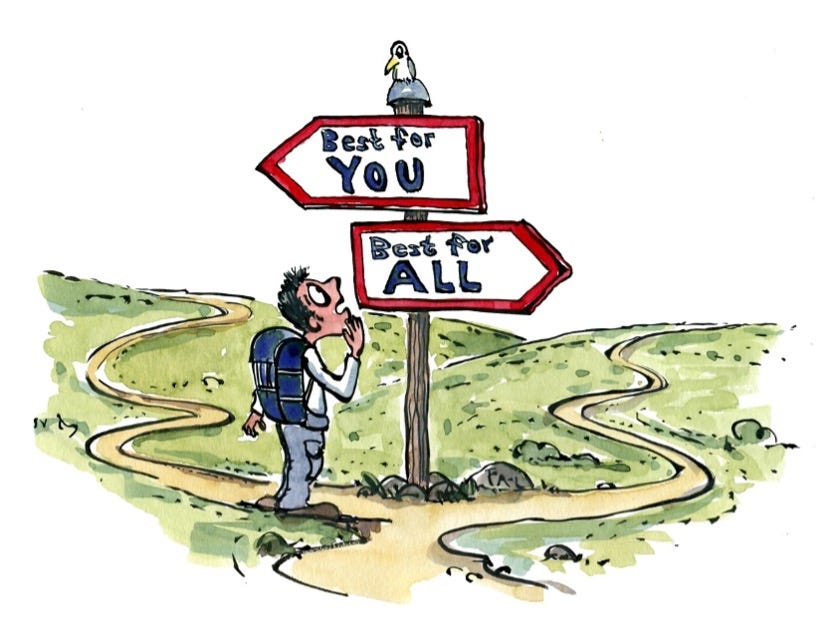
Assumption two: employment is the sensible path; entrepreneurship is the gamble.
This assumption is so deeply embedded in how we raise children and educate young people in Africa that most people do not even notice it operating. School prepares you to be selected — to pass exams, to receive grades, to be evaluated by an institution and found acceptable. The endpoint that education implicitly points toward is a formal employer who will also select you. Everything else — building your own thing, creating your own income streams, building a company from nothing — is framed as either a backup plan or a hobby dressed up as ambition.
What nobody pauses to calculate is the risk profile of employment itself. You can be made redundant. You can be passed over for promotion for a decade while your skills stagnate. You can pour your most productive years into building someone else's vision and retire with a fraction of the equity you helped create. Employment is not the safe path. It is a different risk, dressed in a uniform that society finds reassuring.
Assumption three: they know your situation.
This one is the quiet one. The polite intervention, the well-meaning question, the nudge toward a "real job" — all of it arrives packaged as concern, but it rests on an assumption the person asking has rarely earned the right to make: that they know your financial position, your runway, your plan, your reasoning, and your timeline well enough to weigh in on your choices.
They don't. And most of the time, neither party acknowledges that gap.
Here is the thing I want to be clear about: I am not writing this to shame my schoolmate, or yours, or your parents, or whoever it is in your life who has asked you some version of the same question. They are not villains. They are products of a world that taught them what "real work" looks like, and they are applying that framework to people they love. That is not malice. That is limited information, operating in good faith.
But limited information operating in good faith still causes harm when it is delivered as advice, and absorbed as doubt.
Because here is what happens when someone you respect asks you when you are going to get a real job: a small part of you starts doing the math. Maybe they're right. Maybe I'm being unrealistic. Maybe the responsible thing to do is take the safe path for a year, just to stabilise. And then another year passes. And another. And the thing you were building — the thing that required the full weight of your attention and your courage — gets smaller and smaller, because you kept giving away the hours it needed to something that felt more defensible.
That is the real cost of the question. Not the conversation. The doubt that it plants, and the decisions that grow from that doubt.
At Xcuxion Labs, we are building an institution for the people who have already decided.
Not the people who are testing the waters. Not the people who are keeping their options open while they "see how it goes." The people who have looked at the question — "but when will you get a real job?" — and answered it, quietly and firmly, inside themselves: this is the job. This is the real one.
We believe that building a company from nothing — finding a problem, designing a solution, persuading your first customer, surviving the month when nothing works, waking up and doing it again — is among the most demanding and valuable things a person can do. It creates employment. It builds wealth. It solves problems that governments and NGOs have been unable to solve for decades. It changes the material conditions of communities.
That is not a hobby. That is the work.
And if the people around you cannot see that yet — if they are still asking when you are going to get a real job — you do not need to convince them. You do not need their permission. You do not need to justify yourself to anyone who has not asked to understand.
You just need to keep building. With discipline. With a long time horizon. With other founders around you who understand what this actually costs and what it is actually worth.
That is what the hacker house is for. That is what Batch '27 is for. That is what this institution exists to build.
Applications for Batch '27 are open. If you have already decided, we want to hear from you.