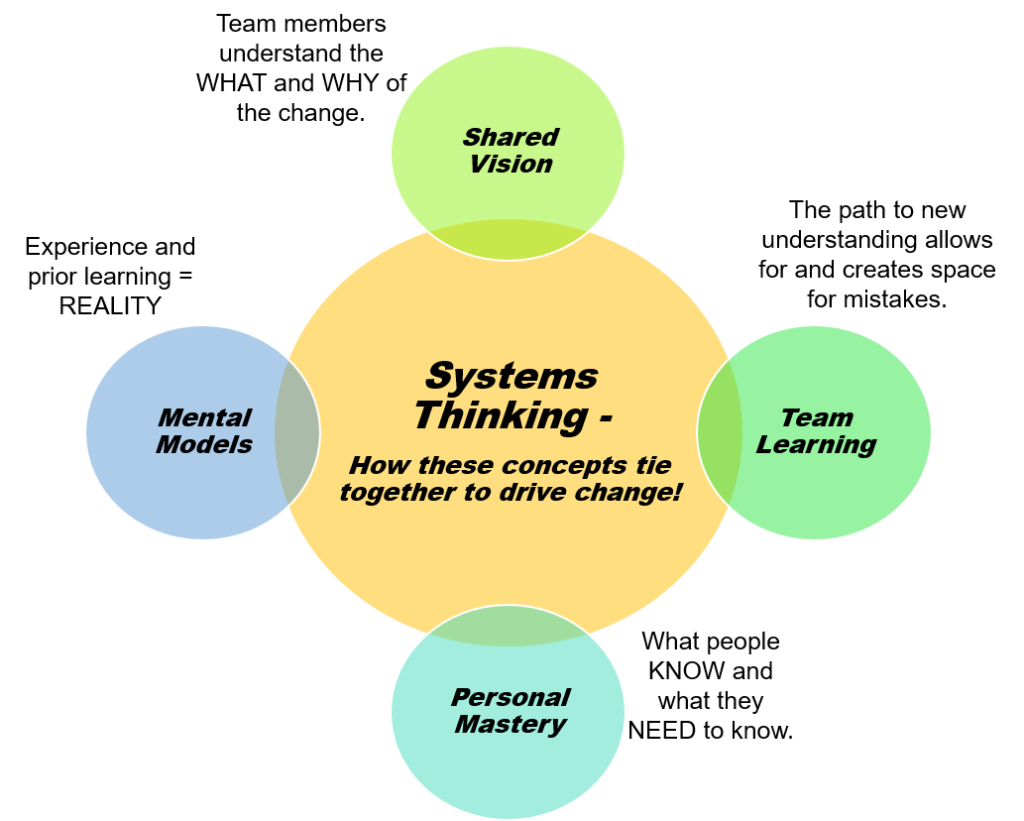
I remember the exact feeling I had about two-thirds through The Fifth Discipline by Peter Senge. Not excitement, exactly. Something closer to recognition — the unsettling experience of reading a description of something you have been living without knowing its name.
The concept that stopped me was deceptively simple: in complex systems, cause and effect are often not closely related in time or space. The thing that is causing your problem today is probably not what happened yesterday. It is what was set in motion months or years ago, in a part of the system that does not look obviously connected to where you are now feeling the pain.
I had been building companies in Ghana for years. I had watched promising ventures — mine and others' — run into walls that nobody could fully explain. The product was good. The team was committed. The market was real. And yet. Something kept not working in ways that were frustrating precisely because they felt almost random. One month's sales would climb. Next, they would collapse. A customer would churn for a reason that seemed unrelated to anything we had done. A problem we thought we had solved would reappear three months later in a different form.
Senge gave me the vocabulary for what I was experiencing. We were not managing our businesses — we were reacting to our systems. And we did not understand the systems we were inside.
What a system actually is.
Donella Meadows opens “Thinking in Systems” with a definition that I want you to sit with: a system is a set of elements interconnected in such a way that they produce their own pattern of behaviour over time.
Read that again. They produce their own pattern of behaviour over time.
Not you produce the behaviour. Not the market produces the behaviour. The system produces it. You, the market, your customers, your competitors, your team — all of these are elements in a system that is generating outcomes according to its own internal logic. Your job as a founder is not to work harder inside the system. Your job is to understand the system well enough to change it.
Meadows gives an example that is worth understanding precisely because it is so ordinary: a thermostat. A thermostat does not simply turn heating on and off. It contains a goal (the desired temperature), a monitoring process (the current temperature), and a correction mechanism (the heater). These three elements connected together produce a behaviour — the room maintains a stable temperature — that none of the elements could produce alone. Remove the goal, and you have a heater with no direction. Remove the monitoring, and you have a goal with no feedback. Remove the correction mechanism, and you have information with no response. The system is the relationship between the elements, not the elements themselves.
Now apply this to your startup. You also have goals — revenue targets, growth rates, customer counts. You also have monitoring — some kind of awareness of how you are performing against those goals. And you also have correction mechanisms — the decisions you make in response to that awareness. The question Meadows forces you to ask is: Are these three elements actually connected in your company? Does your monitoring actually capture the right signals? Does your goal actually reflect what matters? Does your correction mechanism respond to real information or to noise?
For most African early-stage founders, the honest answer is: not reliably. Not because they are not working hard, but because nobody taught them to design the system. They inherited it accidentally, from how other companies did it or from how the programme they went through structured things, and they have been reacting to its outputs without ever examining its design.
The shift from linear to circular thinking.
The most fundamental thing that systems thinking requires is a change in how you see causality. Linear thinking says: A causes B. You launch a product, and customers buy it. You hire a salesperson, and revenue increases. You fix a bug, users stop complaining. The cause precedes the effect, and they are directly and obviously connected.
Circular thinking — which is what systems thinking actually requires — says: A causes B, which feeds back to affect A, which changes B, which loops back again. The product you launch changes what customers expect of you. Those changed expectations affect how they evaluate your next product. Which changes what you build. Which changes what they expect. The loop runs continuously. There is no clear beginning and no clean end.
Senge calls this kind of loop a feedback loop, and he argues that every significant organisational behaviour — growth, stagnation, cycles, collapse — is produced by feedback loops, not by linear cause-and-effect chains.
There are two kinds. Reinforcing loops amplify change in the same direction: growth produces more growth, or decline accelerates decline. Balancing loops resist change and try to maintain a goal or equilibrium. Most real systems contain both, running simultaneously, producing complex patterns that look inexplicable until you see the loops generating them.
In Ghana's startup ecosystem, I have watched a reinforcing loop destroy otherwise promising companies with a regularity that should have prompted more serious investigation. A company gets early traction. The founder raises a small amount of capital and hires quickly, because fast growth is the expectation. The team grows faster than the culture. Communication breaks down. Product quality deteriorates. Customer satisfaction falls. Revenue growth slows. The founder pushes harder — more features, more sales pressure, more hiring. Each intervention makes the underlying problem worse. Not because the founder is incompetent. Because they are trying to solve a system problem with linear interventions, and the system is winning.
If the same founder had understood feedback loops, they would have asked a different question. Not "how do I grow faster?" but "what loop is producing this growth, and what loop will eventually balance it?" The answer to the second question contains everything they needed to know about what would happen next.
Why this matters more in Africa than anywhere else.
I want to make a claim that I think is true and important: systems thinking is more valuable for African founders than for founders anywhere else. Not because African founders are less capable — obviously not. But because African markets are younger, less documented, and less predictable. The feedback loops in them are longer, less legible, and more easily confused with noise.
In a mature market, there is abundant data about what kinds of interventions produce what kinds of results. There are comparable companies to study, investors who have seen the patterns before, and a dense network of institutional knowledge about how the system behaves. An American founder operating in a well-documented vertical can be a reasonable navigator even without deep systems literacy, because the system has been mapped by the people around them.
An African founder operating in a market that has never been formally mapped, in a regulatory environment that is still evolving, in a consumer behaviour landscape that is changing faster than any research can track, in a capital environment where the rules shift with each new wave of global investor interest — that founder is flying blind unless they have developed the ability to read the system from first principles.
Systems thinking is the methodology for flying blind without crashing. It does not give you a pre-drawn map. It gives you the tools to draw the map yourself, in real time, from the signals the system is sending you.
What this series will do.
Over the next six posts, we will go deep into the specific tools and concepts from Meadows and Senge that matter most for African founders. We will cover feedback loops and how to use them intentionally. We will cover the concept of leverage — the places in a system where a small change produces disproportionate effects — and why founders almost always intervene at the wrong leverage point. We will cover the tragedy of the commons and what it means for African markets, where multiple companies are extracting from the same limited resource pool. We will cover mental models — the invisible beliefs about how the world works that determine the quality of every decision a founder makes. And we will cover learning organisations: why the companies that survive and scale in Africa are not the ones with the best product, but the ones that learn faster than their competitors.
None of this is abstract. Each concept will be grounded in the specific realities of building on the continent — in the markets, the constraints, the specific failure patterns that repeat themselves with a regularity that should tell us something about the underlying structure.
The goal of this series is not for you to finish it knowing more. The goal is for you to finish it seeing things differently.
When you see differently, you build differently. And when you build differently in Africa, the outcomes are not just good for your company. They are good for everyone your company touches.
That is the promise of systems thinking for founders. Now let us begin.
This is Post 1 of 7 in the Systems Founder series. Xcuxion Labs helps founders develop the mental frameworks that build companies that last. Applications for Batch '27 are open.