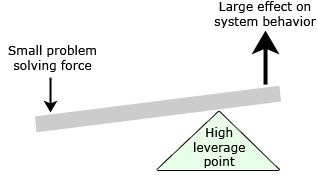
One of the most counterintuitive things I encountered in Thinking in Systems is Donella Meadows' observation that the places in a system with the most leverage — where a small intervention produces the largest change — are almost never the obvious ones. They are rarely where the pain is. They are rarely where attention is focused. And they are very often resisted by everyone in the system, because changing a high-leverage point threatens the assumptions and power structures that everyone inside the system has organised themselves around.
Meadows published a list of leverage points — places to intervene in a system in order of increasing effectiveness. I am going to walk through the most important ones for founders and explain why most of us spend our entire careers operating at the wrong end of the list.
The low-leverage interventions we obsess over.
At the bottom of Meadows' leverage hierarchy are numbers — the parameters and constants that define how quickly things flow through the system. Changing a number rarely changes the fundamental behaviour of a system. If a market is not growing, reducing your price is a numerical change. If customers are not adopting your product, adding more features is a numerical change. If your sales pipeline is thin, hiring another salesperson is a numerical change.
These are not useless interventions. They matter. They affect outcomes. But they do not change the system's fundamental behaviour. They push harder on the same loops that are already running. And if those loops have a structural problem — a balancing constraint they will eventually hit, a delay that is producing oscillation, a goal that is misaligned with what the system is actually optimising for — pushing harder on the numbers makes the structural problem worse, not better.
Most African startup founders I know — and I include my earlier self in this — spend the overwhelming majority of their time on numbers. How do we reduce churn? Improve the product. That is a number. How do we increase conversion? Improve the pitch. Number. How do we grow faster? Hire more salespeople. Number. These are not wrong questions. But they are low-leverage questions. They treat the symptom, not the structure.
The medium-leverage interventions we rarely try.
Moving up the list, Meadows identifies the structure of information flows as a significantly higher leverage point than parameters and constants. Specifically: who has access to what information, and when.
This is extraordinarily relevant to African markets. In most of West Africa's business ecosystems, information asymmetry is not just common — it is the default operating condition. Sellers know things buyers do not. Employers know things employees do not. Established companies know things new entrants do not. Government institutions know things businesses do not. And these asymmetries are not accidental — they are often deliberately maintained because the person who controls information controls the relationship.
A founder who changes the information flows in their market — who makes visible what was previously opaque, who gives buyers access to information that was previously only available to sellers, who gives employees visibility into performance data that was previously held only by management — is intervening at a significantly higher leverage point than a founder who is trying to win on price or feature set.
This is why oper8's most transformative feature is not any individual system. It is the data room. When an African founder using oper8 can show a potential investor a live, real-time view of their financial performance, governance health, product metrics, and team structure, the information asymmetry that has historically disadvantaged African founders in investor conversations disappears. The leverage is not in any individual metric. It is in the structure of the information flow.
The high-leverage interventions that change everything.
Meadows places the rules of the system — the incentives, constraints, and feedback structures that govern how elements in the system behave — well up the leverage hierarchy. And she places the goals of the system — what the system is actually optimising for — even higher.
In a business context, the rules are things like: how you pay your team (what you reward shapes what they do), how you measure success (what gets measured gets managed), how capital is allocated internally (what gets funded shapes what gets built). These are not numbers. They are the architecture of how decisions are made inside the system. Changing them produces qualitatively different behaviour from everyone inside the system, not just quantitatively different outputs.
The goals question is even more fundamental. Meadows argues that a system will produce behaviour consistent with its actual goal — not its stated goal. If a company says its goal is customer satisfaction, but its incentive structure rewards revenue growth at any cost, the system will optimise for revenue growth at any cost. The stated goal is irrelevant. The system is unambiguously pursuing the incentivised goal. Changing the stated goal without changing the goal that the system's feedback structure is actually pointing toward accomplishes nothing.
For an African healthcare startup I worked with briefly, the stated goal was improving patient outcomes in rural Ghana. The actual goal — as revealed by the incentive structure — was demonstrating user numbers to DFI funders who evaluated success by adoption metrics. So the company spent its limited resources on distribution and onboarding, not on the quality improvements that would have actually improved patient outcomes. The patients were a means to the real goal, which was the funder's metrics. The system was optimising for the actual goal perfectly. Nobody had designed it to do this. It was what the incentive structure demanded.
Changing the actual goal — restructuring the incentive alignment with funders, redefining what "success" meant in ways that were tied to patient outcomes rather than adoption numbers — was a high-leverage intervention. It was also the hardest conversation the founder had to have, because the funding relationship was the most powerful external constraint on the system's behaviour. High-leverage interventions are almost always the hardest ones to make.
The highest leverage: changing the paradigm.
At the very top of Meadows' leverage hierarchy, above goals, above rules, above information structures, she places paradigms — the shared ideas, assumptions, and values that give the system its goals, rules, and information flows in the first place.
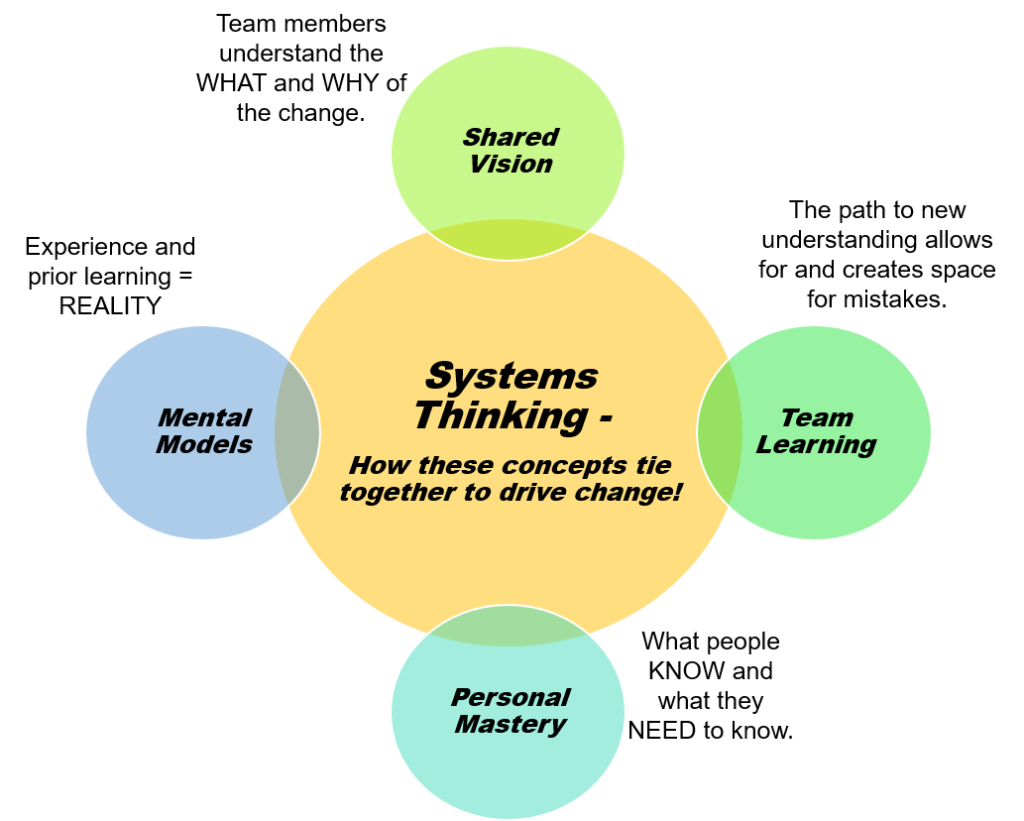
This sounds abstract until you realise that this is exactly what Senge means by the fifth discipline — the one the book is named after. Systems thinking, at its deepest level, is not a set of analytical tools. It is a shift in how you see the world. And when you shift how you see the world, you change what you believe is possible, what you believe is the right way to organise, and what you believe the purpose of building a company actually is.
In Africa's startup ecosystem, there is a dominant paradigm that I believe is one of the highest-leverage things any founder could change. It goes something like this: to build a real company, you need to raise money from foreign investors, build a product that works in the Western model applied to an African context, achieve the metrics that those investors recognise as indicators of success, and either exit to a larger foreign company or raise enough capital to eventually become too big to fail.
Every element of this paradigm can be examined. Is foreign capital the only capital that can build African companies? Clearly not — the companies that have lasted longest in Ghana were not built on foreign VC. Is the Western product model the right default? Sometimes yes, often no — the companies that have produced the most genuine value in African markets have designed from the context, not from an imported template. Are exit-to-acquisition and growth-at-all-costs the right metrics? For some companies, yes, for many no — an African company generating $2M a year in stable revenue, employing forty people, and operating sustainably for twenty years creates more total value for its ecosystem than a company that raised $20M, burned through it at high velocity, and closed in year four.
Changing this paradigm — even partially, even in the way you think about your own company — is one of the highest-leverage acts available to an African founder. Because paradigms govern everything else: the goals you set, the rules you follow, the information you pay attention to, the loops you try to accelerate. Change the underlying belief about what you are building and why, and every decision downstream of that belief changes with it.
This is not the easiest post in this series to read. Leverage points at the top of the hierarchy require more change from the person who wants to use them than leverage points at the bottom. That is why most founders never get there. They are not incapable. They are understandably attracted to the lower-leverage interventions because those interventions feel more controllable, more immediate, and less threatening to the way they currently see the world.
But the founders who change their industries — the ones who build something that genuinely did not exist before, whose companies outlast the hype cycles, whose impact on their communities compounds over decades — those founders found a leverage point near the top of the list and had the courage to push on it.
That is what this series is preparing you for.
This is Post 3 of 7 in the Systems Founder series.